
You pick up a sharpener and there it is. A little row of numbers. 15. 20. 25. 30.
So which one is right for your knife?
It’s one of the most common questions we get. And it matters more than most people think. The knife sharpening angle you choose decides how sharp your blade gets, how long it stays that way, and whether the edge chips the first time it meets a bone.
The good news? You don’t need to be a bladesmith to get it right. Here’s everything you need to know, in plain English.
What Is a Knife Sharpening Angle?
Look at a knife edge up close and you’ll see a tiny V. The sharpening angle is how steep each side of that V is.
A low angle makes a thin, slender V. A high angle makes a short, stubby one. That shape is what decides how your knife behaves when it hits food, rope, hide, or wood.
Angle Per Side vs. Total Angle
Here’s where people get tripped up. There are two ways to measure an edge:
- Per side: The angle of one side of the V. This is how Warthog and most sharpener makers label their settings.
- Total (or inclusive): Both sides added together. A 20-degree per-side edge is a 40-degree total edge.
So if a knife maker says “40 degrees” and your sharpener says “20,” they’re probably talking about the same edge. Always check which one you’re reading.
Why a Few Degrees Makes a Big Difference
Think about a razor blade and an axe. Both are sharp. But you’d never shave with an axe, and you’d never split firewood with a razor.
Every edge is a trade-off between sharpness and toughness:
- Lower angles (around 15°): Thinner edge. Glides through food with almost no effort. Dulls and chips faster under hard use.
- Middle angles (around 20°): A balance of keen slicing and everyday durability.
- Higher angles (25° to 30°): Beefier edge. Handles abuse, bone, and rough work. Takes a little more push to cut.
There’s no “best” angle. There’s only the best angle for the job your knife actually does.
Which Angle Should You Use? A Quick Guide
Here’s the cheat sheet. Find your knife, find your number.
| Angle (per side) | Best For | Examples |
|---|---|---|
| 15° | Precision slicing | Japanese-style knives, sushi knives, fillet knives, thin slicers |
| 20° | Everyday all-around use | Western chef’s knives, paring knives, utility knives, pocket knives |
| 25° | Outdoor and hard use | Hunting knives, skinning knives, camp knives, work knives |
| 30° | Heavy chopping | Cleavers, machetes, bushcraft and survival blades |
15 Degrees: The Precision Slicer
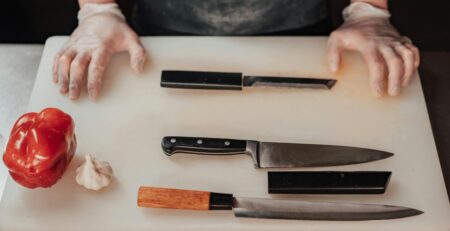
This is the thinnest, keenest edge most knives will ever wear. It’s the go-to for Japanese-style kitchen knives like the santoku, gyuto, and nakiri. It’s also ideal for fillet knives and thin slicing blades.
Use it for tomatoes, fish, herbs, and anything where a clean cut matters. Skip it for bones, frozen food, or prying. A 15-degree edge is a scalpel, not a crowbar.
20 Degrees: The All-Rounder
If you’re not sure where to start, start here. Most Western kitchen knives, including the classic German and American chef’s knife, come from the factory somewhere near 20 degrees.
It’s also a great choice for paring knives, utility knives, and most everyday pocket knives. Sharp enough to slice cleanly. Tough enough to handle daily kitchen life.
25 Degrees: Built for the Outdoors
Hunting and outdoor knives take a beating. They cut through hide, cartilage, rope, and cardboard. They get dropped in the dirt and tossed in the truck.
A 25-degree edge holds up to that kind of work. It won’t feel quite as razor-like as a 15, but it’ll stay sharp through a full day of field dressing or camp chores.
30 Degrees: For the Tough Jobs
This is your heavy-duty setting. Cleavers, machetes, and bushcraft blades that chop wood or split bone need a thick, stubborn edge.
A low angle on a cleaver would chip in minutes. At 30 degrees, the edge can take the impact and keep going.
How to Find Your Knife’s Factory Angle
Before you sharpen, it helps to know what angle your knife came with. Matching it means less metal removed and a faster, cleaner result.
Here are three easy ways to figure it out:
- Check the manufacturer: Many knife makers list the edge angle on their website or in the product manual. Just confirm whether it’s per side or total.
- Consider where it came from: Japanese-style knives usually sit around 15 degrees. Western-style knives usually sit around 20. Hunting and outdoor knives often run 20 to 25.
- Try the marker trick: Color the edge bevel with a permanent marker. Make one light pass through your sharpener, then look closely. If the ink is gone from the whole bevel, you’ve matched the angle. If it’s only gone right at the very edge, your sharpener is set steeper than the bevel. If it’s only gone at the top of the bevel, you’re set too shallow.
Should You Change Your Knife’s Angle?
You can. It’s called reprofiling, and it’s more common than you’d think.
Here’s when it makes sense:
- Your knife keeps chipping: Move up to a higher angle for a tougher edge.
- You want better slicing: Move down to a lower angle, as long as the knife is used gently.
- Your knife’s edge is uneven from past sharpening: Pick one angle and reset it.
Just know that changing angles takes more passes the first time, because you’re reshaping the edge. A coarser hone, like a 270-grit diamond, speeds that up. After the first session, it’s business as usual.
Why Consistency Matters More Than the Number
Here’s the part most people miss. The exact angle you pick matters less than holding that angle the same way every single time.
Freehand sharpening is tough because your hands wobble. One stroke at 18 degrees, the next at 22. Over time that rounds the edge instead of sharpening it. It’s one of the biggest reasons people give up on sharpening, or worse, ruin a good knife.
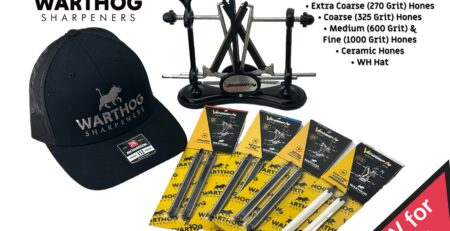
That’s exactly why guided sharpeners exist. Warthog’s patented V-Sharp system locks your angle in place. Two spring-loaded diamond hones sharpen both sides of the blade at once, at the exact same angle. No guesswork. No wobble. Same edge, every time.
Matching Warthog Sharpeners to Your Angle
Every Warthog sharpener is built around a specific range of angles. Here’s how they line up:
- V-Sharp A4 and Elite A4: Four settings of 15, 20, 25, and 30 degrees. The widest range in the V-Sharp line, and the pick if you own Japanese-style or fillet knives.
- V-Sharp Classic II: Three settings of 20, 25, and 30 degrees. A proven workhorse for Western kitchen knives and outdoor blades.
- V-Sharp Curve: Fixed at 25 degrees. No adjustments, no decisions. Great for hunting and outdoor knives on the go.
- Multi-Edge: Infinite angles from 10 to 90 degrees. Built for tools like chisels, scissors, and planer blades.
Knife Sharpening Angle FAQs
What angle should I sharpen a chef’s knife?
It depends on the style. Most Western chef’s knives do best at 20 degrees per side. Japanese-style chef’s knives usually do best at 15 degrees.
Is 15 degrees too sharp for everyday use?
Not if you use the knife the way it’s meant to be used. A 15-degree edge is perfect for slicing and precision work. It’s just not the right choice for bones, frozen food, or heavy chopping.
What angle is best for a pocket knife?
For most everyday carry knives, 20 degrees is a great starting point. If your pocket knife sees rough work like cutting rope or opening crates, 25 degrees will hold up longer.
What angle should I use for a hunting knife?
Most hunting knives do well between 20 and 25 degrees. Go with 20 for finer skinning work and 25 for general field dressing and camp chores.
Can I sharpen serrated knives at these angles?
Yes, with the right hone. Warthog’s ceramic hones fit the A4, Elite A4, and Classic II and are designed for serrated edges. Match the angle to the knife’s existing bevel.
Stop Guessing. Start Slicing.
If you’ve ever wondered whether you’re sharpening your knife right, you’re not alone. Most people have been there. They’ve tried a pull-through gadget, scratched a blade on a stone, or just lived with a dull knife because sharpening felt too risky.
It doesn’t have to be that way.
With a Warthog sharpener, you pick your angle, set it once, and pull the blade through. The V-Sharp system handles the rest, putting an even edge on both sides every time. It’s the same system that was named the World’s Best Manual Sharpener in 2017 and 2018, backed by more than two decades of sharpening experience.
Imagine every knife in your kitchen, tackle box, and hunting pack sharpened to the exact edge it was made for. No more guessing. No more ruined blades. Just knives that work.