Sharpening vs. Honing: What’s Actually the Difference?
You’ve probably heard both words used like they mean the same thing.
They don’t.
Mixing them up is one of the most common reasons people end up disappointed with their knives, either sharpening too often and wearing down the blade, or honing a knife that actually needs real sharpening and wondering why it still won’t cut.
Here’s the difference, in plain English.
Honing realigns. Sharpening removes metal.
Honing doesn’t make a dull knife sharp. It straightens the microscopic edge of the blade, which bends and rolls out of alignment with everyday use. A honing rod (sometimes called a sharpening steel, confusingly) pushes that edge back into place.
Think of it like straightening a bent picture frame nail. The nail isn’t damaged, it’s just bent. Honing fixes that.
Sharpening is different. It actually removes a thin layer of metal to create a new edge. This is what you need when a knife is genuinely dull: when honing doesn’t bring the edge back, because there’s no edge left to realign.
How to tell which one you need
Ask yourself:
- Does the knife still cut, but feel slightly “off” or inconsistent? That’s usually a honing job. A quick pass on a honing rod before you start cooking can make a big difference.
- Does the knife struggle to cut through basic things: tomato skin, an onion, paper? That’s a sharpening job. Honing won’t fix it.
- Has it been weeks or months since the last real sharpening? Time to sharpen, not hone.
A good rule of thumb: hone often, sharpen occasionally. Many home cooks hone before nearly every use and sharpen every few weeks to few months, depending on how often they cook and what they’re cutting.
Why this matters more than people think
Sharpening removes metal. Every time you sharpen a knife, you’re taking a small amount of the blade away permanently. That’s not a bad thing, it’s necessary, but it means over-sharpening a knife that only needed honing shortens its life for no reason.
On the flip side, honing a knife that actually needs sharpening just wastes your time. You’ll feel like you’re doing maintenance, but the knife won’t perform any better.
Knowing the difference means your knives last longer, perform better, and you spend less time fighting with a blade that isn’t doing its job.
Getting a real edge when you need one
When it’s actually time to sharpen, not just hone, you want a system that’s consistent every time. Uneven sharpening angles are one of the biggest reasons knives feel unpredictable from one use to the next, and they’re the reason so many people give up on freehand sharpening altogether.
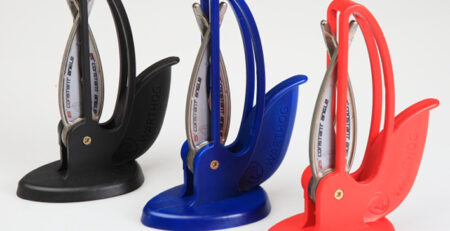
The VSharp A4 and Elite A4 use Warthog’s patented V-Sharp system to sharpen both sides of the blade evenly, so you’re not guessing at angles by hand. For quick touch-ups between full sharpenings, the V-Sharp Curve is compact and fixed at a reliable 25-degree angle, no adjustment needed.
Stop guessing. Start knowing.
If you’ve been honing a knife for weeks and it still won’t cut cleanly through a tomato, honing was never going to fix it. It needed real sharpening. And if you’ve been sharpening every few days out of habit, you’ve probably been wearing down a blade that just needed a quick straighten.
Once you know the difference, maintaining your knives stops being a guessing game. You hone often to keep an edge aligned, and you reach for a real sharpener only when the blade actually needs it, which means your knives last longer and perform better every time you pick one up.
Ready to get a true edge instead of a temporary fix? Browse the full Warthog lineup and find the sharpener built for how often, and how seriously, you use your knives.